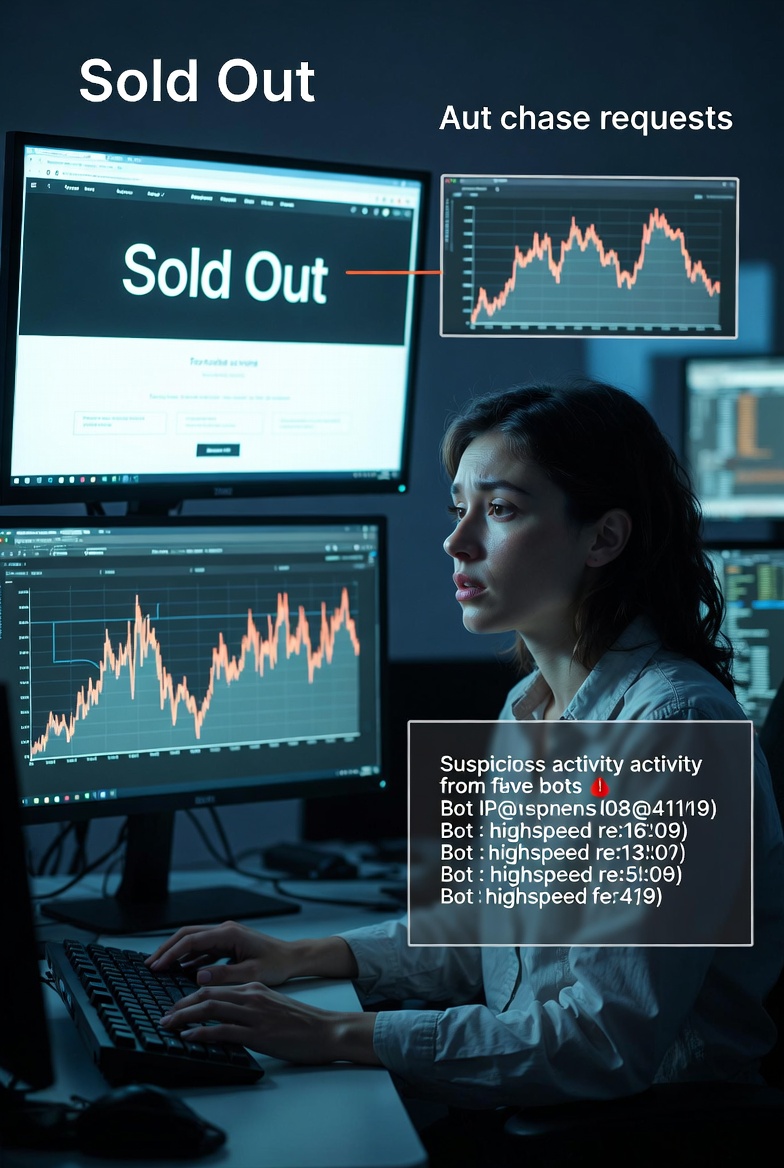
At exactly 10:00 AM, the new smartphone launch went live.
Within seconds, the website traffic exploded.
Thousands of users rushed to buy the limited-edition device. The company had prepared for high traffic, scaling their servers and optimizing performance.
Everything seemed under control.
Until the products started disappearing.
Not slowly.
Instantly.
Within less than a minute, the entire stock was sold out.
Customers were confused.
“How is that possible?”
“I clicked immediately!”
“Was it even available?”
The support team was flooded with complaints.
Something didn’t feel right.
Zainab, a backend engineer, quickly checked the order logs.
What she saw was strange.
Hundreds of purchases were completed in milliseconds.
No human could move that fast.
She dug deeper.
All the suspicious orders came from a small number of IP addresses, each sending rapid, repeated requests to the checkout API.
That’s when she realized the truth.
Bots.
Automated scripts designed to buy products faster than any human could.
These bots were programmed to:
- Monitor the product launch
- Instantly add items to cart
- Complete checkout in milliseconds
Zainab looked at the request patterns.
The bots were bypassing normal user behavior, sending direct API requests instead of using the website interface.
The system had no protection against this.
No rate limiting.
No bot detection.
No request validation.
The bots had taken advantage of that.
Within minutes, resellers had bought nearly all the stock.
Zainab acted quickly.
She implemented **rate limiting**, restricting how many requests a user or IP address could make within a short time.
She also added **CAPTCHA verification**, forcing users to prove they were human before completing a purchase.
Finally, she introduced request validation to ensure that only legitimate user actions could trigger checkout.
The next product restock was scheduled later that day.
This time, the system was ready.
At launch, traffic surged again.
But things were different.
Bots tried to flood the system.
They were blocked.
Real users were able to complete purchases.
The stock sold out again—but this time, fairly.
Later, Zainab reflected on what happened.
Automation is powerful.
But in the wrong hands, it can create unfair advantages and break systems.
That’s why developers must design systems that don’t just work…
But also protect against abuse.
Because sometimes, the fastest user isn’t a person at all.
It’s a bot.