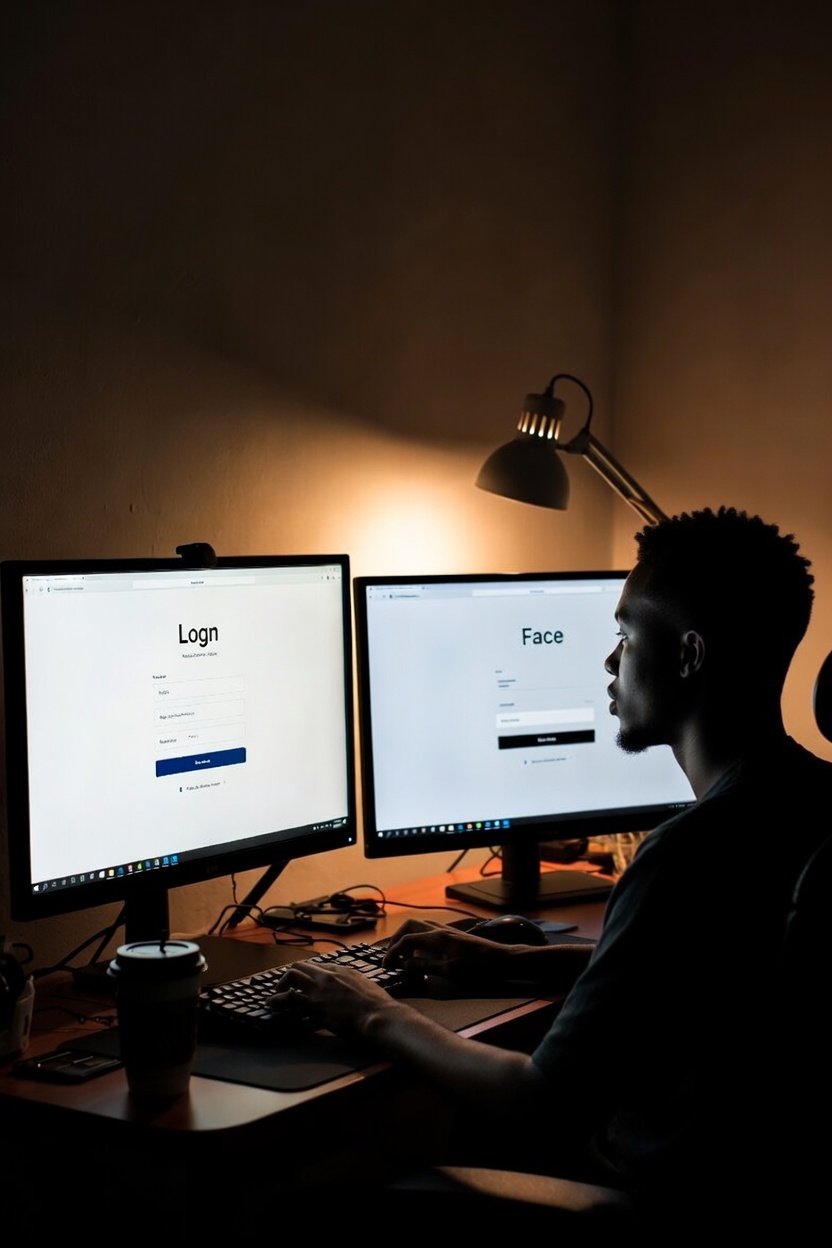
It was past midnight, and the office was almost empty. Ibrahim, a cybersecurity engineer, sat alone in front of his workstation, the soft glow of multiple monitors lighting up the dark room. Earlier that evening, several users had reported unusual activity — accounts being accessed without permission, passwords changed, and in some cases, money transferred without their knowledge.
At first, it seemed like a typical security incident. Maybe weak passwords. Maybe reused credentials. But something didn’t feel right.
Ibrahim opened the company’s monitoring dashboard and began tracing login activity. He noticed a strange pattern — many of the affected users had logged in within the same time window, but from different locations. That didn’t make sense.
Curious, he decided to investigate further.
He pulled up the login page that users had accessed. At first glance, everything looked normal. The logo was correct. The design was identical. The input fields were exactly the same.
But Ibrahim had learned one thing in cybersecurity — attackers rely on people not paying attention to small details.
He opened the real website in another tab and placed both pages side by side.
That’s when he saw it.
The URLs looked almost identical, but there was a tiny difference — a single letter slightly altered. Easy to miss. Almost invisible to the average user.
His heart rate increased.
“This is a phishing attack,” he whispered.
He quickly inspected the fake page’s code and traced where the login data was being sent. It led to a remote server.
On another screen, he opened a live network monitor.
What he saw confirmed his fears.
A stream of usernames and passwords was being captured in real time. Every second, new data appeared — details from users who believed they were logging into the real platform.
The attacker had created a perfect copy of the login page and tricked users into entering their credentials.
The room suddenly felt heavier.
This wasn’t just a bug or a system error. This was deception.
Ibrahim immediately took action.
He reported the malicious domain, blocked it at the network level, and alerted the internal team. He also triggered a forced password reset for affected users and enabled additional security measures.
As the stream of stolen credentials slowly stopped, Ibrahim leaned back in his chair.
The attack had been clever. Simple, but effective.
It didn’t break the system.
It tricked the users.
That night, Ibrahim was reminded of an important truth in cybersecurity:
Sometimes, the biggest threats don’t come from complex code…
But from how easily people can be fooled.